

ASCP Hematology Exam Content Guidelines Per ASCP BOC
The ASCP BOC designs the ASCP hematology exam content guidelines for hematology certification and preparation.
This guideline is the exam syllabus for the hematology exam: H ASCP (Technologist in Hematology) and SH ASCP (Specialist in Hematology).
You'll have to answer 100 multiple-choice questions that cover topics including hematology physiology, hematology diseases states, hematology laboratory testing, hemostasis, and lab operation.
The exam is administered in a computer adaptive testing format, and the exam duration is 2.5 hours.
The ASCP Board of Certification awards extremely potent certificates, including the hematology certification, that are enough to change professional life in all aspects.
Because passing the ASCP exam, including the H and SH ASCP, is challenging; the board determines the exam syllabus for all certifications.
ASCP hematology exam content guidelines work for both hematology technologists (H) and hematology specialists (SH) certificate exams.
No matter whether you are a U.S. or international hematologist, it works to encompass the ASCP hematology certification exam.
In this article, we will explore the ASCP hematology exam content per ASCP BOC guidelines.
Hematology Physiology: ASCP Hematology Exam Content Guidelines
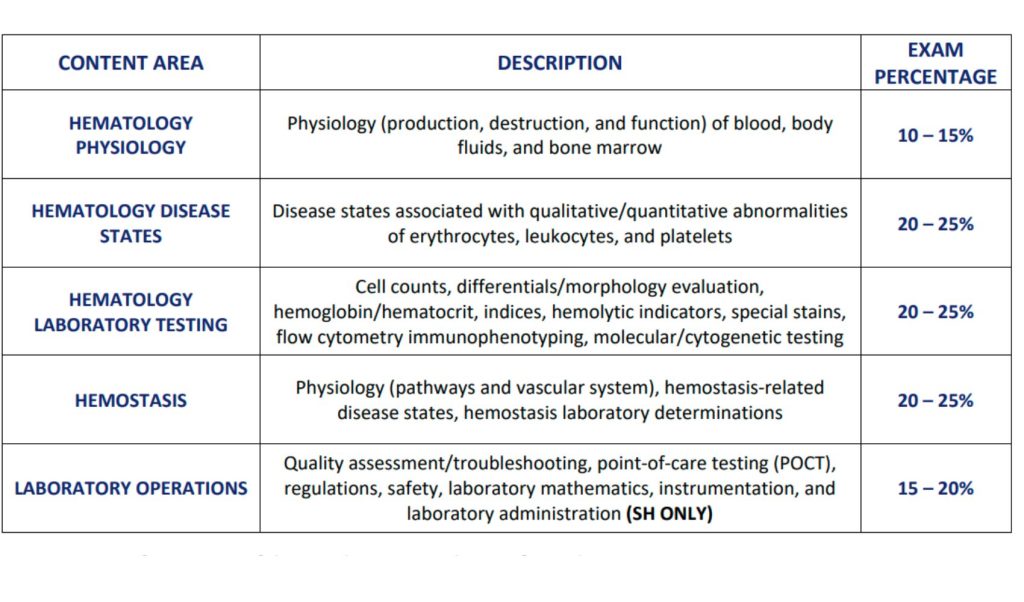
Hematology physiology comprises the bone marrow, body fluids, and blood.
It contributes 10-15% of questions for both the H ASCP and SH ASCP exams.
Classification of hematology physiology: destruction, production, and function.
Hematology Disease State: ASCP Hematology Exam Content Guidelines
Hematology disease states concentrate on three major categories: Erythrocytes, Leukocytes (WHO classification), and Platelets.
The ASCP BOC derives 20-25% of exam questions from this content area.
Further description of hematology disease states:
Erythrocytes
- Anemia: Chronic inflammation, Sideroblastic, Thalassemia, Microcytic
- Normocytic: Acute hemorrhage, Hypoproliferative, Acquired hemolytic, Hereditary hemolytic
- Macrocytic: Megaloblastic and Nonmegaloblastic
- Hemoglobinopathies: Relative and Absolute
Leukocytes (WHO classification)
- Benign leukocyte diseases: Lymphoid, Myeloid
- Myeloid neoplasia: Myeloproliferative neoplasms, Myelodysplastic syndromes, Acute leukemia
- Lymphoid neoplasia: Acute leukemia, Chronic lymphoma/leukemia, Plasma cell dyscrasias
- Hereditary anomalies
Platelets
- Quantitative abnormalities: thrombocytosis and thrombocytopenia (increased destruction [HIT, TTP, ITP], decreased production, pseudothrombocytopenia).
- Qualitative defects: Glanzmann thrombosthenia, Bernard-Soulier syndrome, von Willebrand disease.
Hematology Laboratory Testing: ASCP Hematology Exam Content Guidelines
The hematology lab testing is specified to offer 20-25% exam questions for hematology specialist and technologist exams.
Its major classification includes cell counts, differentials and morphology evaluation, hemoglobin, hematocrit, indices, hemolytic indicators, cytogenetic and molecular testing, flow cytometry immunophenotyping, and others.
Cell Counts (blood & body fluids)
- Reticulocyte
- Automated
- Manual
Differentials & Morphology Evaluation (blood & body fluids)
Hemoglobin
- Quantitative
- Qualitative: Sickle solubility, HPLC, and Electrophoresis
Hematocrit
Indices
Hemolytic Indicators (e.g., LD, haptoglobin)
Special Stains
- Kleihauer-Betke
- Prussian blue
- Myeloperoxidase
- Esterase
Other Studies
- Heinz body
- G-6-PD
- ESR
Flow Cytometry Immunophenotyping
- PNH
- Lymphocyte subsets
- Lymphoma
- Leukemia
Cytogenetic and Molecular Testing
- JAK2
- BCR/ABL1
- Recurring cytogenetic abnormalities
Hemostasis: ASCP Hematology Exam Content Guidelines
Physiology, disease states, and laboratory determinations are hemostasis key topics that it covers.
The ASCP BOC concludes the 20-25% questions from this area.
Physiology
- Vascular system
- Fibrinolytic pathway
- Coagulation pathways
Disease States
- DIC
- Hypercoagulable states
- Fibrinolytic system
- Inhibitors
- Coagulation factor deficiencies (Hereditary and Acquired)
Laboratory Determinations
- Heparin neutralization
- Mixing studies
- Platelet aggregation
- Factor assays
- Fibrinogen
- Direct thrombin inhibitors
- Inhibitor assays
- D-dimer
- Thromboelastography
- Hypercoagulability assessment: Molecular (prothrombin 20210, Factor V Leiden, etc) and assays (Protein C, Protein S, lupus anticoagulant, etc.)
- Anti-Xa
- Factor assays
- PT/INR
- von Willebrand assays
- Platelet function
- APTT
- Thrombin time
Laboratory Operation: ASCP Hematology Exam Content Guidelines
The lab operation offers nearly 20% of questions for the H and SH ASCP exams.
It concentrates on almost all the areas of lab work, including quality assessment/troubleshooting, safety, laboratory mathematics, instrumentation, and laboratory administration (SH only).
Further classification of lab operation sub-types:
Quality Assessment/Troubleshooting
- Quality control
- POCT (Point-of-care testing)
- Regulation (accreditation standards, competency assessment, proficiency testing, etc.)
- Pre-analytical, analytical, and post-analytical
Safety
- Transportation and packaging of samples
- Emergency practices (splashes to mucous membranes, needlesticks, fire, etc)
- SDS (Safety data sheets) for reagents and chemicals
- Safe work approaches
- Use of PPE ( personal protective equipment)
- infection prevention with bloodborne pathogens
- Safety techniques and programs
Laboratory Mathematics
- Standard curves
- Mode, confidence intervals, median, and mean
- Molarity and normality
- Volume, concentration, and dilutions
- Specificity, sensitivity, and predictive value
Instrumentation
- Centrifuges
- Cell counters
- Differential analyzers: Scatter plots, Digital imaging, Histograms
- Point-of-care analyzers
- Microscopes
- Coagulation analyzers
Laboratory Administration (for SH ASCP only)
- Operations: Test verification and validation, information technology, data management, facility management ( utilities, lab design), and customer service.
- Financial: Capital equipment acquisition, inventory & purchasing, capital equipment acquisition, and budgets.
- Quality management: medical-legal issues/risk management, IQCP (Individualized Quality Control Plan), and continuous quality improvement.
- Personnel: Productivity and staffing, conflict resolution, disciplinary action, & counseling, Performance standards
Calculations for H and SH ASCP
- Manual hemocytometer counts
- Corrected WBC counts when > 10 nRBCs present
- Absolute cell counts given the relative values (reticulocytes, WBCs)
- Red blood cell indices (MCV, MCHC, MCH, etc)
Reference Ranges for H and SH ASCP
| Conventional Units | SI Units | |
| RBC | 4.00 – 6.00 x 10⁶ /μL | 4.00 – 6.00 x 10¹² /L |
| HGB | 12.0 – 18.0 g/dL | 120 – 180 g/L |
| HCT | 35% – 50% | 0.35 – 0.50 L/L |
| MCV | 76 – 100 fL | 76 – 100 fL |
| MCH | 26 – 34 pg | 26 – 34 pg |
| MCHC | 32 – 36 g/dL | 320 – 360 g/L |
| RDW | 11.5 – 14.5% | 0.115 – 0.145 |
| Reticulocytes (absolute) | 20 – 115 x 10³ /μL | 20 – 115 x 109/L |
| Reticulocytes (relative) | 0.5 – 2.5% | 0.005 – 0.025 |
| nRBCs | 0 nRBC/100 WBC | 0 nRBC/100 WBC |
| Platelets | 150 – 450 x 10³ /μL | 150 – 450 x 10/L |
| WBC (total) | 3.6 – 10.6 x 10³/μL | 3.6 – 10.6 x 10⁹ /L |
| Neutrophils (absolute) | 1.7 – 7.5 x 10³/μL | 1.7 – 7.5 x 10⁹ /L |
| Neutrophils (relative | 50 – 70% | 0.50 – 0.70 |
| Lymphocytes (absolute) | 1.0 – 3.2 x 10³/μL | 1.0 – 3.2 x 10⁹/L |
| Lymphocytes (relative) | 18 – 42% | 0.18 – 0.42 |
| Monocytes (absolute) | 0.1 – 1.3 x 10³/μL | 0.1 – 1.3 x 10⁹/L |
| Monocytes (relative) | 2 – 11% | 0.02 – 0.11 |
| Eosinophils (absolute) | 0 – 0.3 x 10³/μL | 0 – 0.3 x 10⁹/L |
| Eosinophils (relative) | 1 – 3% | 0.01 – 0.03 |
| Basophils (absolute) | 0 – 0.2 X 10³/μL | 0 – 0.2 x 10⁹/L |
| Basophils (relative) | 0 – 2% | 0 – 0.02 |
| Hgb electrophoresis | ||
| Hgb A | > 95.0% | > 0.95 |
| Hgb F | 0 – 2.0% | 0 – 0.02 |
| Hgb A2 | 0 – 3.5% | 0 – 0.035 |
| Fluid counts | ||
| CSF: WBC and RBC | 0 – 5/μL | 0 – 5 x 10⁶/L |
| Synovial fluid: WBC | 0 – 200/μL | 0 – 200 x 106/L |
Reference Ranges for SH Only
| Conventional Units | SI Units | |
| PT | 11.0 – 14.0 seconds | 11.0 – 14.0 seconds |
| APTT | 25.0 – 35.0 seconds | 25.0 – 35.0 seconds |
| Fibrinogen | 160 – 415 mg/dL | 1.60 – 4.15 g/L |
| Thrombin time | ≤ 21.0 seconds | ≤ 21.0 seconds |
| Coagulation factor activity | 50 – 150% | 0.50 – 1.50 |
Interested in Blood Banking, Check ASCP Exam Content Here?
FAQs for ASCP Hematology Exam Content Guidelines
What is the name of the ASCP hematology exam content guidelines?
Hematology physiology, hematology disease states, hematology laboratory testing, hemostasis, and lab operation.
What is the length of the H and SH ASCP certificate exam?
H and SH ASCP exams consist of 100 MCQs, that you need to cover in a given time frame (2.5 hours).
What is the difference between the H ASCP and SH ASCP exams?
H ASCP is the hematology exam that is established for technologists, while the SH ASCP is also a hematology exam, but it is conducted for specialists.
Does the ASCP BOC determine the same exam content areas for H ASCP and SH ASCP?
Yes, of course, the ASCP Board of Certification designs the same SCP hematology exam content guidelines for H and SH ASCP.

Abdelhalim Elshawadfy is an ASCP certified Medical Laboratory Scientist (MLS ASCP), Specialist in Microbiology (SM ASCP), and Molecular Biology Technologist (MB ASCP) with a distinguished career marked by expertise, continuous learning, and a commitment to elevating the standards of clinical laboratory science. As an ASCP Certification Expert and American Board Certification Expert, Abdelhalim Elshawadfy continues to make invaluable contributions to the field, leaving a lasting impact on the medical community.
Resources: ASCP BOC.